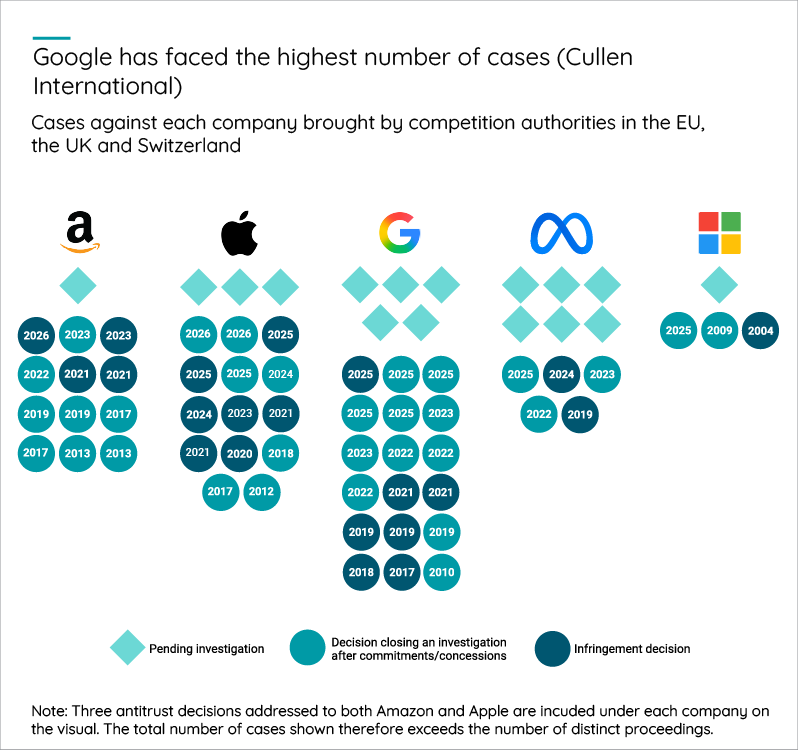
European competition authorities have brought more than 60 antitrust cases against five major US tech firms – Amazon, Apple, Google, Meta and Microsoft. Of these, 16 investigations remain pending, while nearly 50 cases have resulted in infringement decisions or been closed following commitments or concessions from the companies.
This sustained enforcement activity under traditional antitrust rules comes alongside the EU's Digital Markets Act (DMA), which introduced a new layer of ex ante regulation targeting certain digital services of big tech companies.
Key takeaways
- Antitrust enforcement remains strong alongside the DMA. Since the DMA became applicable in May 2023, competition authorities across Europe have opened more than a dozen new antitrust investigations. Over the same period, 21 cases were concluded with an infringement decision or concessions from the companies.
- National competition authorities are driving ongoing antitrust scrutiny. Of the 16 antitrust investigations currently pending, 14 are being conducted at the national level. The European Commission’s two open probes target AI-related conduct by Google and Meta.
- Abuse of dominance remains the main focus. Most cases concern alleged abuses of a dominant position, which are prohibited under both EU and national competition laws. In addition, Germany has pursued several cases under its special antitrust rules for large digital platforms.
These findings are drawn from Cullen International’s latest report on past and pending antitrust cases against big tech companies in Europe.
The report tracks enforcement activity under ex post antitrust rules at EU and national level. It provides an overview of the cases and links to detailed analytical summaries in Cullen International's Antitrust & Mergers Database.
Scope
Region: Europe
Countries covered: 30 (EU-27, Norway, Switzerland, UK)
Policy area: Competition, Antitrust
Last updated: November 2026
For more information and access to the report, click 'Access full content' – or 'Request access' if you are not yet a subscriber to our Antitrust & Mergers Service.
more news
30 October 26
Many governments around the globe rely on legal mechanisms to compel communications apps to cooperate in law enforcement investigations
Cullen International's latest Global Trends benchmark for number-independent communications apps regulation found that nearly all of the 13 surveyed jurisdictions around the world provide some legal mechanism to make these apps assist law enforcement in criminal investigations. There are requirements to verify user identities, compel disclosure of stored content, make encrypted content accessible, and duties to detect illegal content within private communications.
22 October 26
IoT regulation: new operational requirements reshape global connectivity
Cullen International's Quarterly Regulatory Update on IoT and M2M Services (Q3 2026) highlights how national regulators around the globe are shaping the future of IoT and M2M services.
21 October 26
Americas countries require satellite service providers to obtain a spectrum licence
Cullen International’s latest benchmark compares satellite regulation across the Americas, including service and spectrum licensing, registration requirements, spectrum allocations and fees, interference rules, migration between frequency bands and recent regulatory developments.