Cullen International’s new Tracker makes a comparison between the European Commission’s 2 GHz band MSS proposals and the existing framework.
It includes a detailed analysis of the proposed selection procedures, eligibility and ranking criteria, spectrum allocation, fees, licence duration, transfer and leasing rules, transitional arrangements and the legislative process.
Adjusting to new circumstances
The proposed regulation of May 2026 would replace the current framework with a centralised EU process for selecting, authorising and overseeing operators in the band. It would also substantially reshape how the 2 GHz MSS band is allocated, reserving the majority of the spectrum for EU-owned or controlled operators. The existing spectrum rights held by Inmarsat (acquired by Viasat in 2023) and Solaris (acquired by EchoStar in 2014) are due to expire in May 2027.
The proposal reflects growing demand for satellite connectivity, internet-of-things (IoT) and direct-to-device (D2D) services, as well as increased EU focus on security, resilience, technological sovereignty and strategic autonomy. It is also closely linked to the EU-level satellite authorisation framework proposed under the Digital Networks Act (DNA).
Three parallel selection procedures
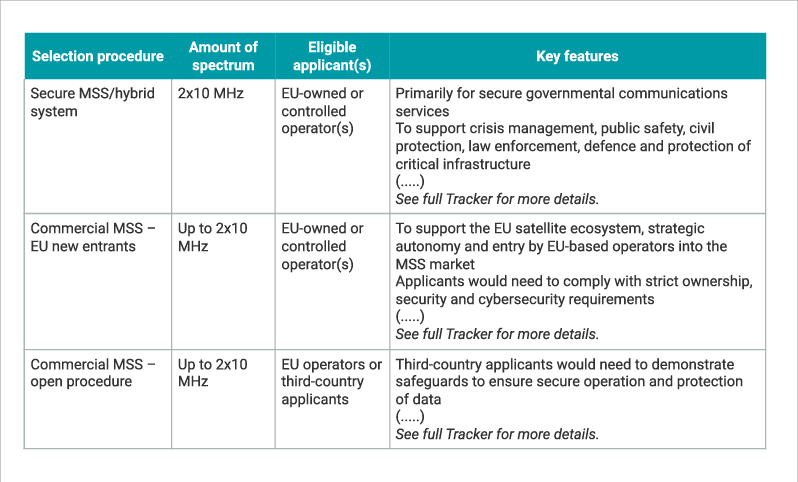
The draft regulation’s key feature is the introduction of three parallel selection procedures:
 For more details and for access to the full benchmark, please click on “Access the full content” - or on “Request Access”, in case you are not subscribed to our European Telecoms service.
more news
07 September 26
Regulators in most Americas countries use the weighted average cost of capital (WACC) to test wholesale pricing
Cullen International’s new Americas benchmark shows that ten of the surveyed countries employed WACC to calculate regulated wholesale prices or to settle disputes between operators.
04 September 26
Competent authorities for EU data rules
Cullen International’s latest Benchmark compares the authorities designated or proposed to enforce the Data Governance Act and the Data Act across 21 EU member states, including their respective roles and responsibilities.
01 September 26
Sustainability Podcast: environmental impact of the postal sector
New Sustainability podcast on the environmental impact of the postal sector.